
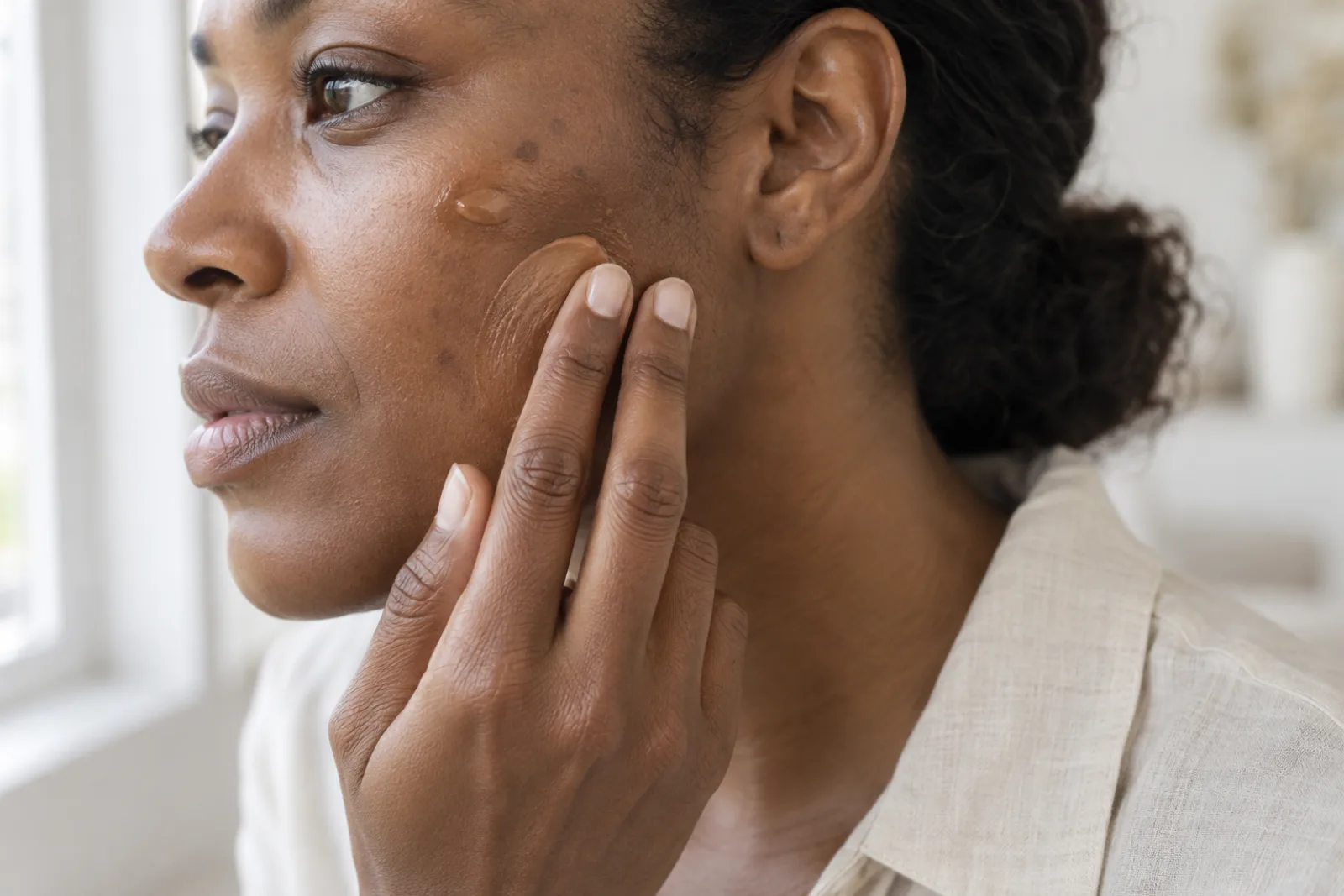
Do I need sunscreen if I have dark skin?
You do. Having more melanin, the pigment that colours your skin, does not spare you dark spots. Post-inflammatory hyperpigmentation, the marks left behind by pimples, scratches or a rash, is more common in darker skin, and DermNet notes that it is also more intense and lasts longer there. The same page says the patches may get darker when sunlight hits them.
That is why the American Academy of Dermatology (AAD) says treatment for dark spots begins with sunscreen. A 2022 review in the American Journal of Clinical Dermatology agrees: avoiding the sun and wearing sunscreen are essential to keep hyperpigmentation and melasma from developing or getting worse. The same review found that studies consistently report low sunscreen use among Black people.
Skin cancer is the other reason. The AAD is clear that anyone can get it, whatever their skin tone.
For how dark spots form in the first place, read our guide to hyperpigmentation on dark skin.
[S7][S1][S5][S3]Why tinted sunscreen? Because of visible light
Sunlight is more than UV. Roughly half of what reaches the ground is visible light, the part you can see. A 2023 review in the Journal of Clinical Medicine sums up what the studies show: on dark skin, visible light triggers darkening that is stronger and longer-lasting than the darkening from long-wave UVA. In lighter skin, one of those studies could not detect any pigment response to blue and green light.
This is where ordinary sunscreen falls short. UV filters, chemical or mineral, do not block visible light well enough. According to the review, broad-spectrum sunscreens without visible light protection failed to stop dark spots from getting darker and melasma from coming back.
Tinted sunscreen closes that gap. The tint comes from iron oxides, which are mineral colour pigments. They block visible light, and in studies an iron oxide tinted sunscreen clearly reduced the darkening. The AAD recommends it by name for dark spots.
[S4][S1][S3]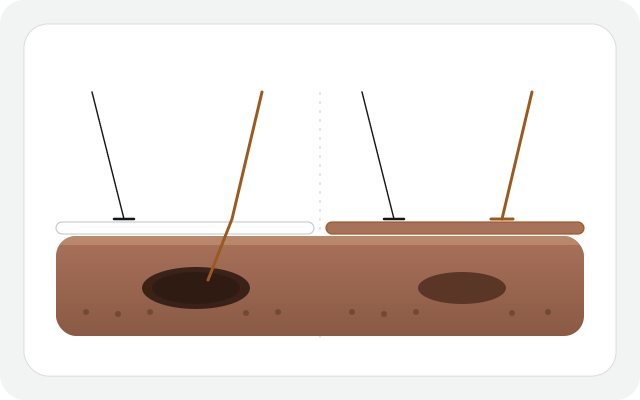 UVvisible lightUVvisible lightUntinted: spot gets darkerTinted: both stay out
Schematic illustration · not a before-and-after or a treatment result
What is the best sunscreen for hyperpigmentation on dark skin? Five label checks
No brand names needed. You can check these five things on any tube:
- Tinted, with iron oxides. Iron oxides are not UV filters. On US labels the AAD says to look under “inactive ingredients”. On European packs they often appear as colour numbers. CI 77492, for one, is a yellow iron oxide.
- SPF 30 or higher. The AAD and Germany’s Federal Office for Radiation Protection (BfS) both recommend it. For dark spots on exposed skin, DermNet advises SPF 50+.
- Broad spectrum. That means protection against UVA as well as UVB.
- A shade that suits you. The AAD says to pick a tint that blends with your skin tone. Go too light and you are left with a grey film.
- Non-comedogenic if your skin is oily. The word means the product will not clog pores.
The AAD also counts “water-resistant” among its basics. You will be glad of it once you sweat or swim.
We’re working on a sunscreen of our own right now. If you’re buying one today, make it tinted.
[S1][S2][S6][S7][S9]Sunscreen with no white cast: why some formulas turn dark skin grey
You rub it in and your face looks dusted with flour. That is the white cast. No wonder the tube ends up in a drawer.
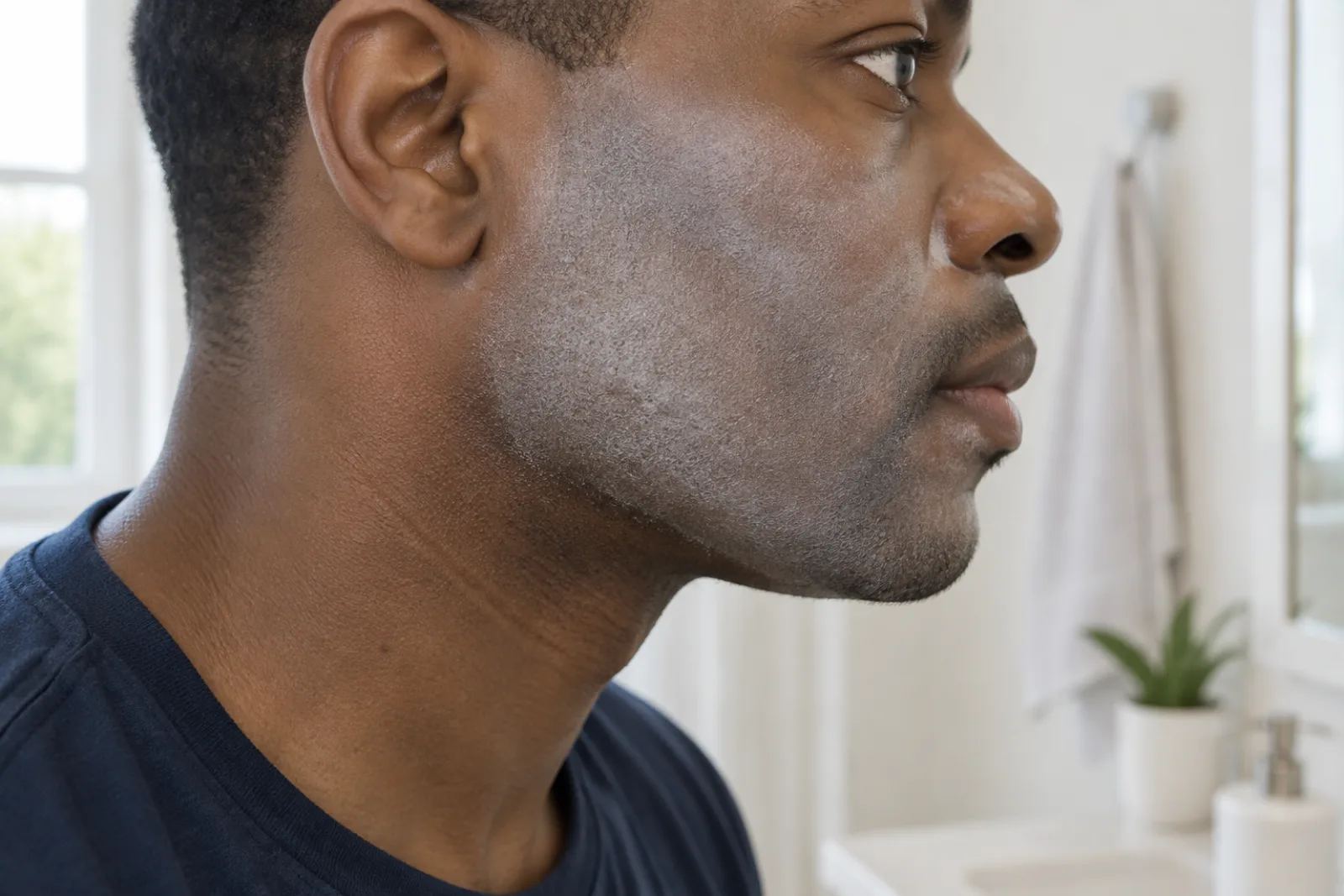
- 01White cast: untinted sunscreen
- 02Neck: his natural skin tone
The film comes from the product. Your skin is not the problem, and a matching tint avoids it.
Illustration
The cast usually comes from mineral filters, meaning titanium dioxide and zinc oxide. The BfS describes them as insoluble filters that scatter and reflect UV radiation as well as absorbing it. The review on photoprotection for skin of colour notes that they leave a white residue many darker-skinned people find cosmetically unacceptable. Applied at the recommended amount, it adds, the white hue of many formulas makes them impractical on dark skin.
The fix is the same one that deals with visible light. In the AAD’s words, a tinted sunscreen that matches your skin tone helps you avoid the white residue. Tinted formulas combine pigments such as iron oxides with the mineral filters. One product then gives you visible light protection and a colour that suits your skin.
[S6][S5][S2][S3]How much sunscreen, when, and how often?
The SPF on the label only holds if you use the full amount. According to the AAD, many people apply just 20 to 50% of it.
- Face: at least one teaspoon, says the AAD.
- Body: the AAD puts it at about one ounce for an adult. The BfS works with 2 milligrams per square centimetre of skin.
- Timing: before you go out. The AAD says 15 minutes ahead, the BfS 20 to 30.
- Reapplying: every two hours outdoors, and straight after swimming, towelling off or sweating.
Reapplying keeps your protection up. It does not extend it, a point the BfS makes explicitly. One layer at breakfast will not carry you through a day outdoors.
Cover all skin your clothes leave exposed. People tend to forget their ears, neck and the backs of their hands.
[S3][S6][S1]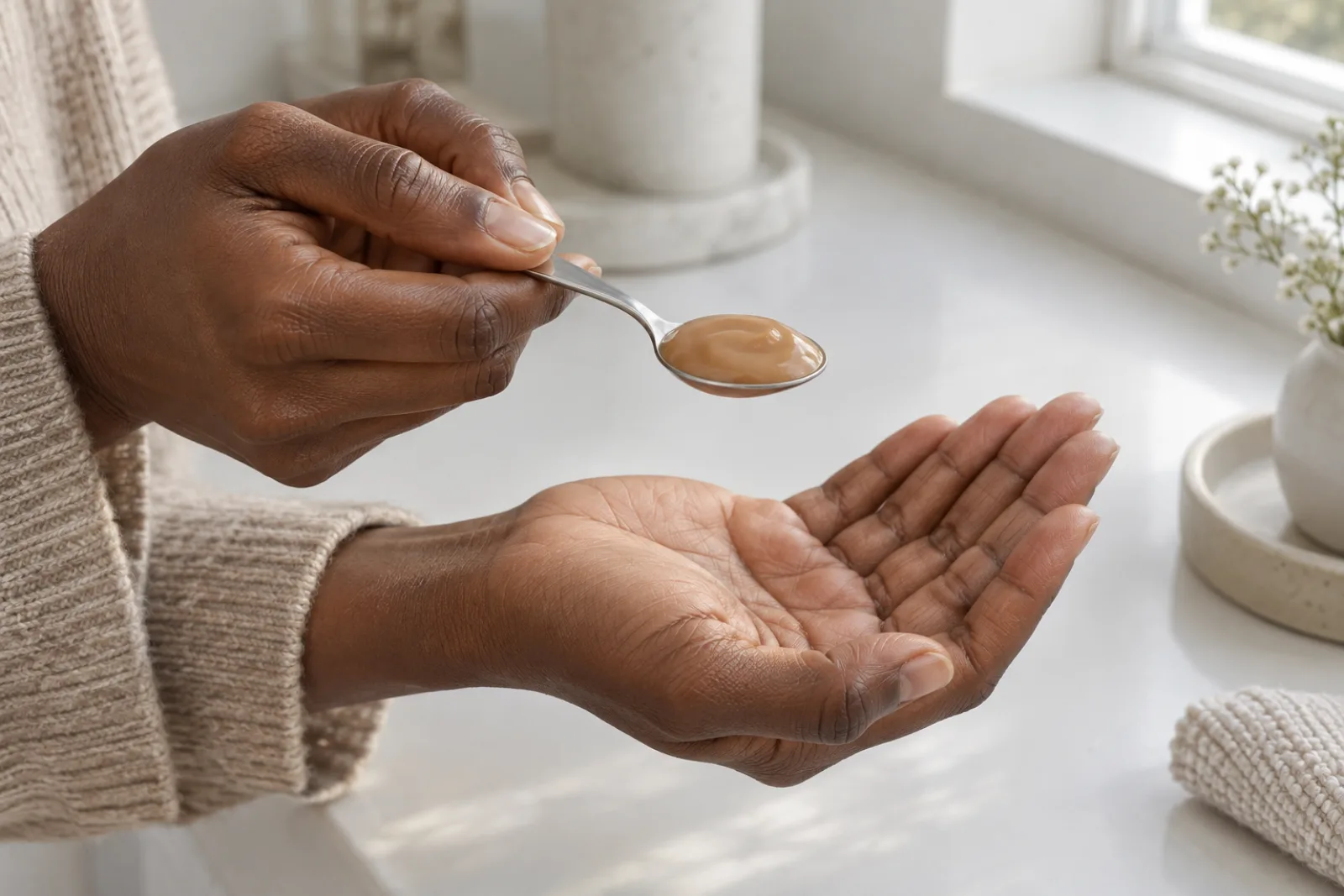
This is the minimum for your face, according to the AAD.
Illustration
What goes under your sunscreen?
Sunscreen stops spots from getting darker. It does not actively fade them. Fading is the job of an active ingredient, and vitamin C is on the AAD’s list of over-the-counter ingredients that can fade dark spots.
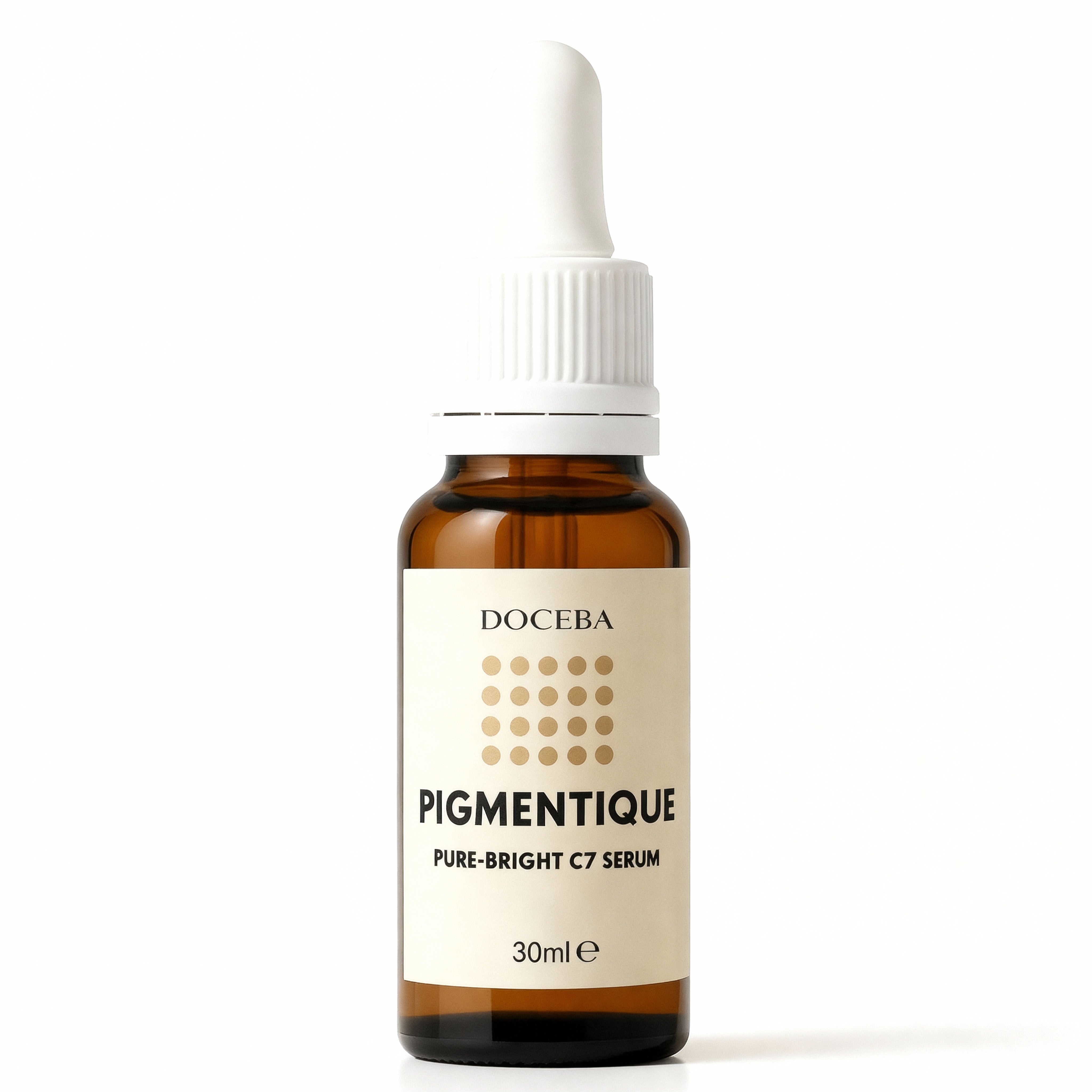
A morning looks like this: gentle cleanser, treatment serum, moisturiser, then sunscreen last. Our Pure Brightening Set covers everything before the sunscreen. It contains a cleanser, the Pure Bright C7 Serum, a Booster Serum and the Barrier Lipid Shield Cream. There is no sunscreen in the set, so you need one alongside it.
The full order for morning and night is in Skincare routine for hyperpigmentation on dark skin. What vitamin C can and cannot do is covered in Vitamin C for dark spots.
[S1][P3]Why do I still get dark spots when I wear sunscreen?
You put it on every morning and the spots stay, or even deepen. Annoying, yes. But one of these five reasons is nearly always behind it:
- Your sunscreen is not tinted. Visible light gets through, and on dark skin it can darken a spot.
- You use too little or never reapply. A thin layer at breakfast will not last until evening.
- The trigger is still active. While new pimples keep coming or a product keeps irritating your skin, new spots keep forming. The AAD says to deal with the cause first. If something burns or stings, stop using it.
- You expect results too soon. According to the AAD, a spot a few shades darker than your natural colour usually fades within 6 to 12 months once the cause is gone. Colour that sits deeper can take years.
- It is melasma. Stricter rules apply, which the next section covers.
Sunscreen is also only part of sun protection. The AAD recommends a wide-brimmed hat outdoors and staying out of the sun when it is strongest, which it puts between 10 a.m. and 2 p.m.
More on this in Why are my dark spots getting darker? and Does hyperpigmentation go away on its own?. If your whole face is darker than the rest of you, see Why is my face darker than my body?.
[S4][S6][S1]
- 01Brim: forehead and cheek in shade
The AAD recommends a wide-brimmed hat whenever you are outdoors.
Illustration
Sunscreen for melasma
Melasma shows up as darker patches. Only a dermatologist can tell you whether your patches are melasma.
Visible light has been shown to worsen melasma, especially in darker skin tones. So the AAD recommends a sunscreen that contains iron oxide and has SPF 30 or higher, worn every day, cloudy days included. Add shade and a wide-brimmed hat.
Our Pure Bright C7 Serum fits as the vitamin C step. Our Mela Bright is still in development. If you don’t see it linked here yet, it isn’t online yet.
If nothing shifts despite sunscreen and a steady routine, see a dermatologist. The AAD says some dark spots need a prescription-strength treatment.
[S8][S1]From the lab
We don’t have a sunscreen of our own yet. We are working on it. Until it is ready, use the checklist above. It works with any product that passes all five checks.
A shelf product stays the same in every phase. Your skin doesn’t. Because Anita formulates in our own lab in Bielefeld, we can adjust a product when your skin needs something different. That is what Skin Protocol is for.
Your next step
Both routes are fine. Pick the one that fits you today.
- Buy a tinted sunscreen with iron oxides and SPF 30 or higher, in a shade close to your skin.
- Use a teaspoon for your face each morning and reapply every two hours outdoors.
- Take a photo once a month in the same light. If nothing changes or new spots appear, see a dermatologist.
Matching products from our lab:

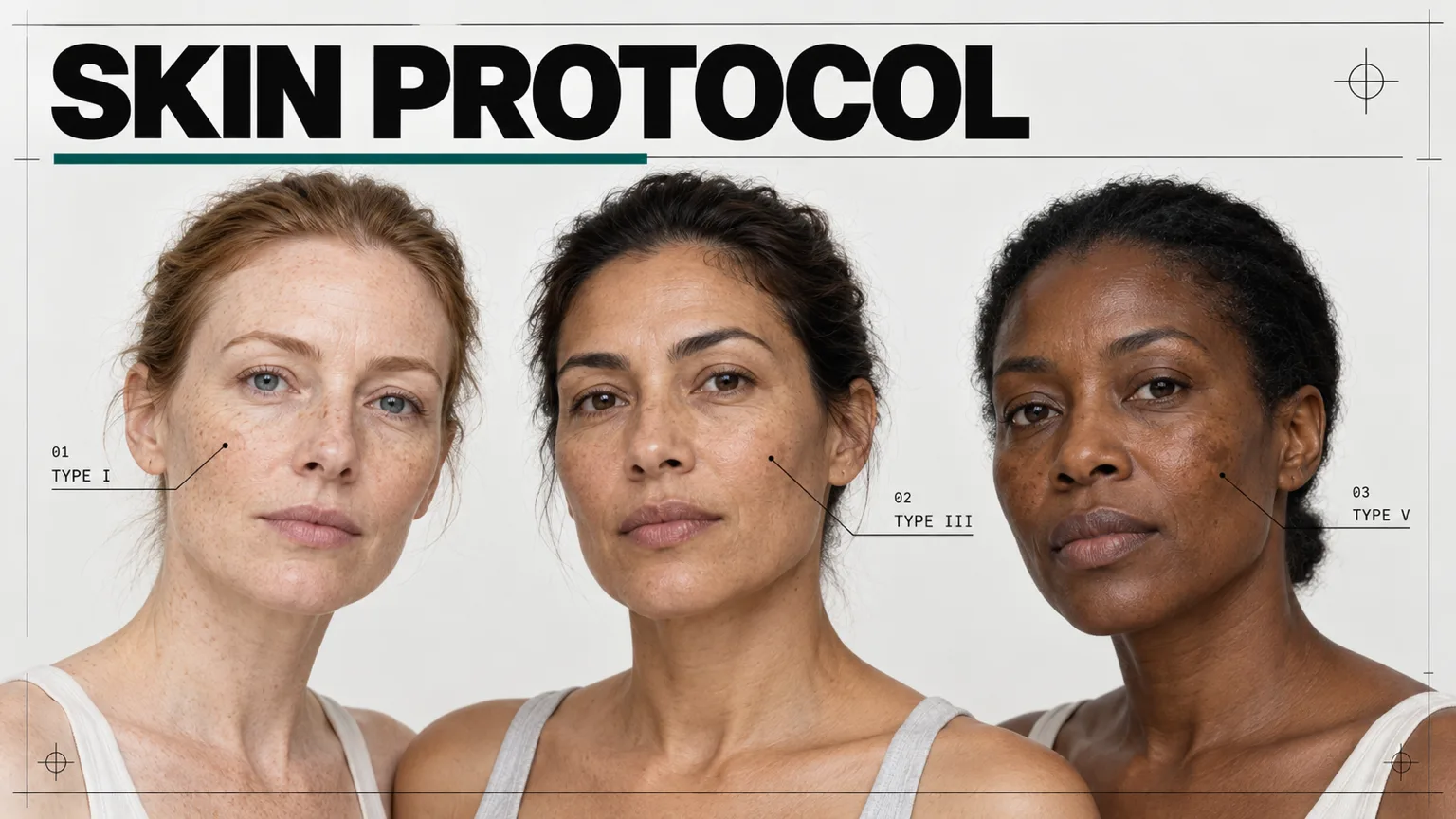
Skin Protocol: a plan for your skin and a team that adjusts it
You get a plan built around your skin and what you’ve already tried. We check in regularly and adjust products from Anita’s lab when your skin needs something different. In English or German.
It starts with a free 20-minute call. We ring you and listen to your skin story, including spots that stay despite sunscreen.
Book your free skin callCosmetic advice, not a diagnosis. If you think you have a skin condition, see a doctor first.
Questions you might still have
What SPF should dark skin use?
SPF 30 or higher, the level both the AAD and Germany’s BfS recommend. For dark spots on skin that sees the sun, DermNet advises SPF 50+. [S2][S6][S7]
What is an iron oxide sunscreen?
A tinted sunscreen. Iron oxides are the colour pigments that give it its shade, and the AAD says they help protect skin from visible light, a cause of dark spots. They are not UV filters, so look for them in the ingredient list. On European packs they often appear as colour numbers such as CI 77492. [S1][S3][S9]
Does sunscreen fade hyperpigmentation?
It keeps spots from getting darker and gives them time to fade. The AAD says a spot a few shades darker than your natural colour usually fades within 6 to 12 months once the cause has stopped. Treatment may speed that up. [S1]
Which sunscreen leaves no white cast on dark skin?
A tinted one in a shade that matches you. The AAD names tinted sunscreen as the way to avoid white residue. Untinted formulas with titanium dioxide or zinc oxide often leave a cast on dark skin. [S2][S3][S5]
Sources
- [S1] AAD: How to fade dark spots in darker skin tones ↗
- [S2] AAD: How to select a sunscreen ↗
- [S3] AAD: Sunscreen FAQs ↗
- [S4] He X et al.: The Emerging Role of Visible Light in Melanocyte Biology and Skin Pigmentary Disorders: Friend or Foe? J Clin Med 2023;12(23):7488 ↗
- [S5] Tsai J, Chien AL: Photoprotection for Skin of Color. Am J Clin Dermatol 2022;23(2):195–205 ↗
- [S6] Bundesamt für Strahlenschutz (BfS): Sonnencreme ↗
- [S7] DermNet: Postinflammatory hyperpigmentation ↗
- [S8] AAD: Melasma: Self-care ↗
- [S9] COSMILE Europe: CI 77492 ↗
- [P2] DOCEBA: Pigmentique Pure Bright C7 Serum ↗
- [P3] DOCEBA: Pure Brightening Set ↗
General skincare information, not a diagnosis or an individual treatment plan.
Your bag
Review your items before continuing.
Your bag is empty.