

Maybe you already have a routine for your face, but the dark spots on your arms, back or knees stay. By summer at the latest, when more skin shows, you notice them.
Let me sort it out. Many dark spots on the body are colour left behind after inflammation or an injury. On knees and elbows, friction often adds to it. Vitamin C can be one building block for both.
I'll show you what vitamin C can do on the body, how to use it in three steps and when to have the spots checked.
Does vitamin C work on dark spots on the body?
Vitamin C acts at a key step of pigment production. It blocks tyrosinase, the enzyme that makes melanin. Less melanin means less colour in the spot.
Vitamin C sits next to azelaic acid, glycolic acid, kojic acid and retinoids among the over-the-counter ingredients that can fade existing dark spots. Vitamin C cream is also used for post-inflammatory hyperpigmentation (PIH), the colour left behind after an injury or inflammation. Significant improvement usually takes a combination of steps. We do not carry azelaic acid, glycolic acid, kojic acid or retinoids. Our serums rely on vitamin C.
The evidence has limits, because clinical studies on topical vitamin C are limited. We know of no study that looks at dark spots on the body in dark skin specifically. Vitamin C may help, and nobody can promise it will. Here vitamin C is cosmetic care that helps dark spots look lighter.
[S1][S2][S3]
- 01Tyrosinase makes pigment
- 02Vitamin C slows it down
- 03Less pigment
Vitamin C inhibits tyrosinase, the enzyme that makes melanin.
Simplified illustration
Where do dark spots on the body come from?
In medium to dark skin tones, something often prompts the skin to make extra melanin. Dark spots appear, for example, after a pimple or a patch of psoriasis clears, after a wound from an insect bite, cut or burn heals, or when a skin or hair care product irritates the skin. Certain medications and hormonal changes such as pregnancy can play a part too.
The leftover colour is called PIH. It can occur in anyone, but it is more common in darker skin types, where the colour tends to be more intense and last longer than in lighter skin.
On the back and shoulders, a healed pimple can leave such a mark. What helps there is covered in dark spots on the back. For the legs, see dark spots on the legs.
[S2][S3]
- 01Small darker marks
On the back, a healed pimple can sometimes leave a dark mark.
Illustration
Why are knees and elbows often darker?
Where skin is rubbed or pressed again and again, it thickens and looks darker. Doctors call this FADES, short for frictional asymptomatic darkening of the extensor surfaces, meaning the outer sides of knees and elbows.
Doctors recommend avoiding friction. Creams with lactic acid or urea are considered modestly effective in some cases as well. In daily life that can mean resting your forearm instead of your elbow on the desk, using a knee pad when kneeling and swapping tight trousers above the knee. A scrub with grains or a pumice stone, on the other hand, adds more friction.
Underarms have their own article on dark underarms.
[S4]
- 01Dab cream on the spot
For single spots such as the knee, a cream you dab on gives you control.
Illustration
How do I use vitamin C for dark spots on my body?
Pick a product made for the body. Our Pure Bright C7 Serum is a face serum and stays on the face. For arms, shoulders, back and legs we offer the Pure Bright C7 Body Serum, a spray. On large areas a spray spreads quickly, and for single spots like knees or elbows a cream gives you more control. We know of no study that compares vitamin C body lotions, sprays and creams.
Test a new product on a small spot first and add only one at a time. After that, every morning: actives go right after cleansing, and moisturiser after that.
- Wash your skin in the morning and pat it dry.
- Apply the vitamin C, then your moisturiser.
- Finish with sunscreen on uncovered skin. Vitamin C underneath helps neutralise free radicals, the unstable molecules that form when UV light hits skin and that sunscreen only partly blocks.
If a product burns or stings, stop using it. Irritated skin can turn into a dark spot itself, because inflammation prompts pigment cells to make more melanin.
[S1][S2][S3][S5]Do I need sunscreen on my body when I use vitamin C?
Yes, sunscreen is the foundation of any dark spot treatment. A tinted product with iron oxides, SPF 30 or higher and broad-spectrum protection suits best, applied to all skin that clothing does not cover. Iron oxides protect against visible light, which can darken spots too.
We are working on our own sunscreen. If you buy one now, choose a tinted one.
Reapply every two hours, and after swimming or sweating.
[S2]
Sunscreen goes on every area you treat.
Illustration
How long does it take, and when should I see a doctor?
A spot a few shades darker than your skin usually fades within 6 to 12 months once the cause is stopped. If the colour sits deep in the skin, it can take years. Treatment can speed up fading. We know of no timeframe for vitamin C on the body, so we do not give one.
Dark spots are among the most common reasons people with darker skin tones see a dermatologist. If you don't know what caused a spot and you are unsure, a visit to a dermatologist is a good idea. Never stop a medication on your own. Ask the doctor who prescribed it whether discolouration is a possible side effect.
[S2]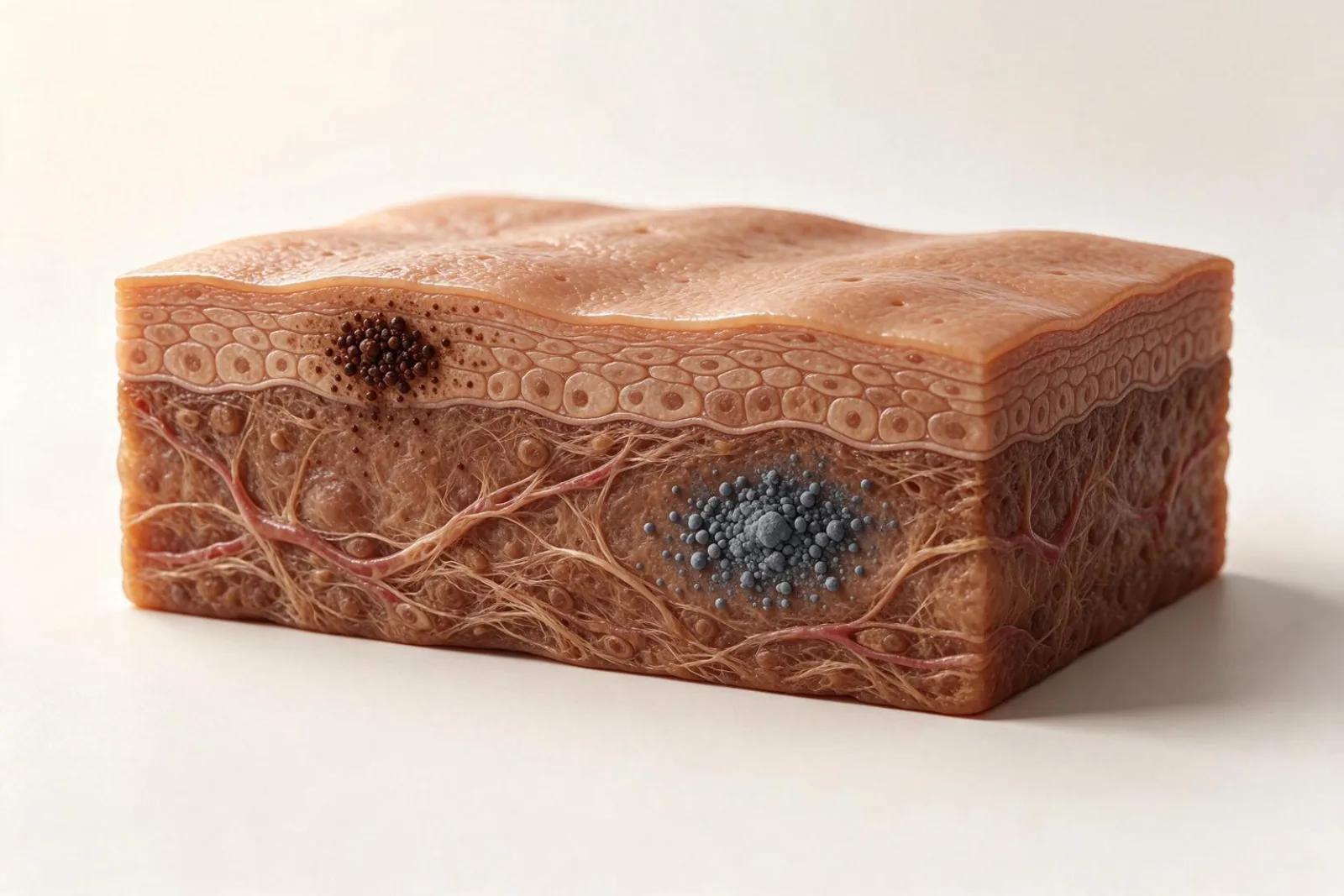
- 01Near the top: usually fades in months
- 02Deep: often takes longer
Pigment near the surface fades faster than pigment deeper down.
Simplified illustration
What is your next step?
You can start on your own or get support.
Your plan for the first weeks
- Reduce friction: rest your forearm instead of your elbow, use a knee pad, swap tight trousers.
- Apply vitamin C in the morning: spray on larger areas, cream on single spots.
- Wear tinted sunscreen on uncovered skin during the day and reapply every two hours.
- Test new products on a small spot first and add only one at a time.
Matching products
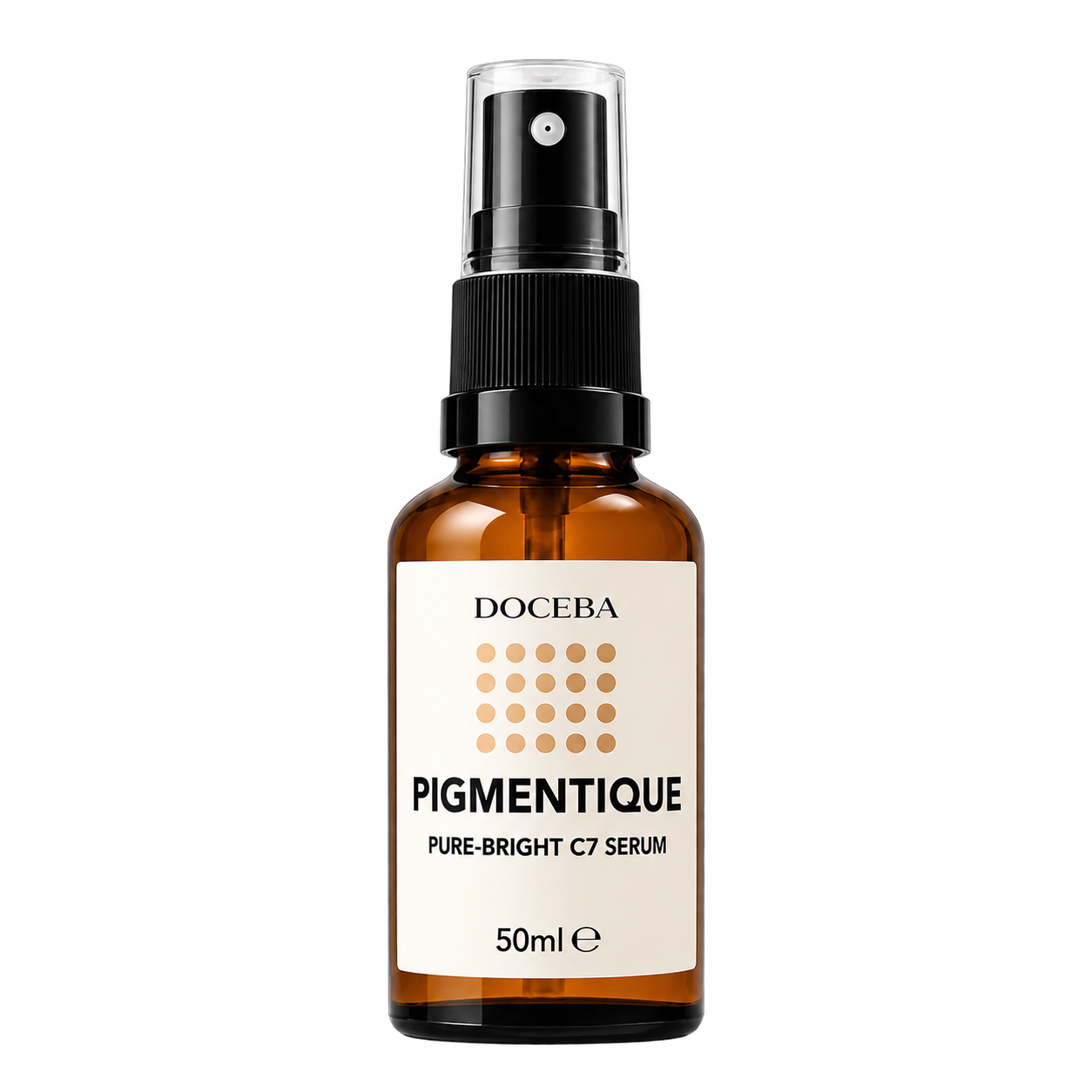
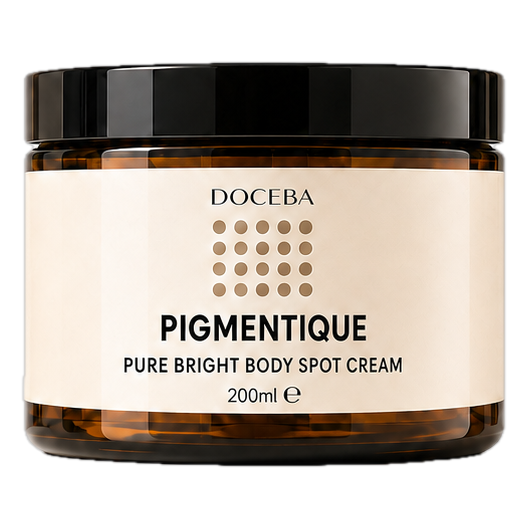
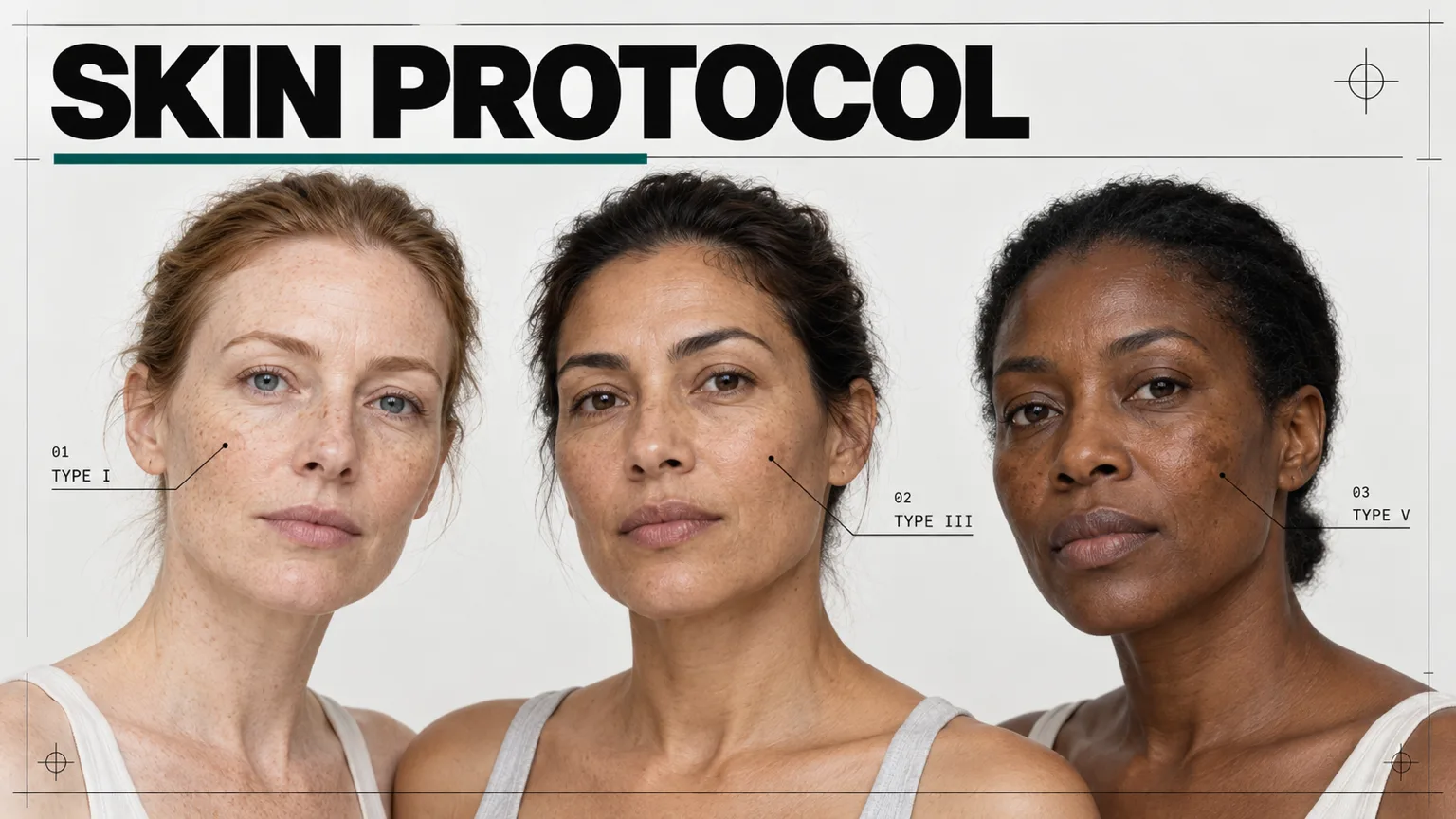
Skin Protocol: a plan for your skin and a team that adjusts it
You get a plan built around your skin and what you've already tried. We check in regularly and adjust products from Anita's lab when your skin needs something different. In English or German.
It starts with a free 20-minute call. We ring you and listen to your skin story, including your routine for dark spots.
Book your free skin callCosmetic advice, not a diagnosis. If you think you have a skin condition, see a doctor first.
Frequently asked questions about vitamin C on the body
Can I use my vitamin C face serum on my body?
We do not recommend it. Our Pure Bright C7 Serum is made for the face. For the body there is the C7 Body Serum spray and the Body Spot Cream. The body products in turn stay on the body.
When do I apply vitamin C on my body?
Morning makes sense, because vitamin C helps neutralise free radicals that sunscreen only partly blocks. Apply it after cleansing, then moisturiser, and sunscreen last. [S1][S5]
What should I do if the product burns?
Stop using it. If a product burns or stings, it is irritating your skin, and irritated skin can develop dark spots. Test new products on a small spot first. [S2][S3]
Is a vitamin C body lotion better than a spray?
We know of no comparison of these forms. A spray spreads quickly over large areas, and a cream can be applied to single spots. Choose what you will actually use every morning.
How long until dark spots on the body fade?
A spot a few shades darker than your skin usually fades within 6 to 12 months once the cause is stopped. If the colour sits deep, it can take years. Treatment can speed up fading. [S2]
Sources
- [S1] Al-Niaimi F, Chiang NYZ: Topical Vitamin C and the Skin: Mechanisms of Action and Clinical Applications. J Clin Aesthet Dermatol 2017;10(7):14–17 ↗
- [S2] American Academy of Dermatology: How to fade dark spots in darker skin tones ↗
- [S3] DermNet: Postinflammatory hyperpigmentation ↗
- [S4] Krishnamurthy S, Sigdel S, Brodell RT: Frictional asymptomatic darkening of the extensor surfaces. Cutis 2005;75(6):349–355 ↗
- [S5] American Academy of Dermatology: Should I apply my skin care products in a certain order? ↗
General skincare information, not a diagnosis or an individual treatment plan.
Your bag
Review your items before continuing.
Your bag is empty.