
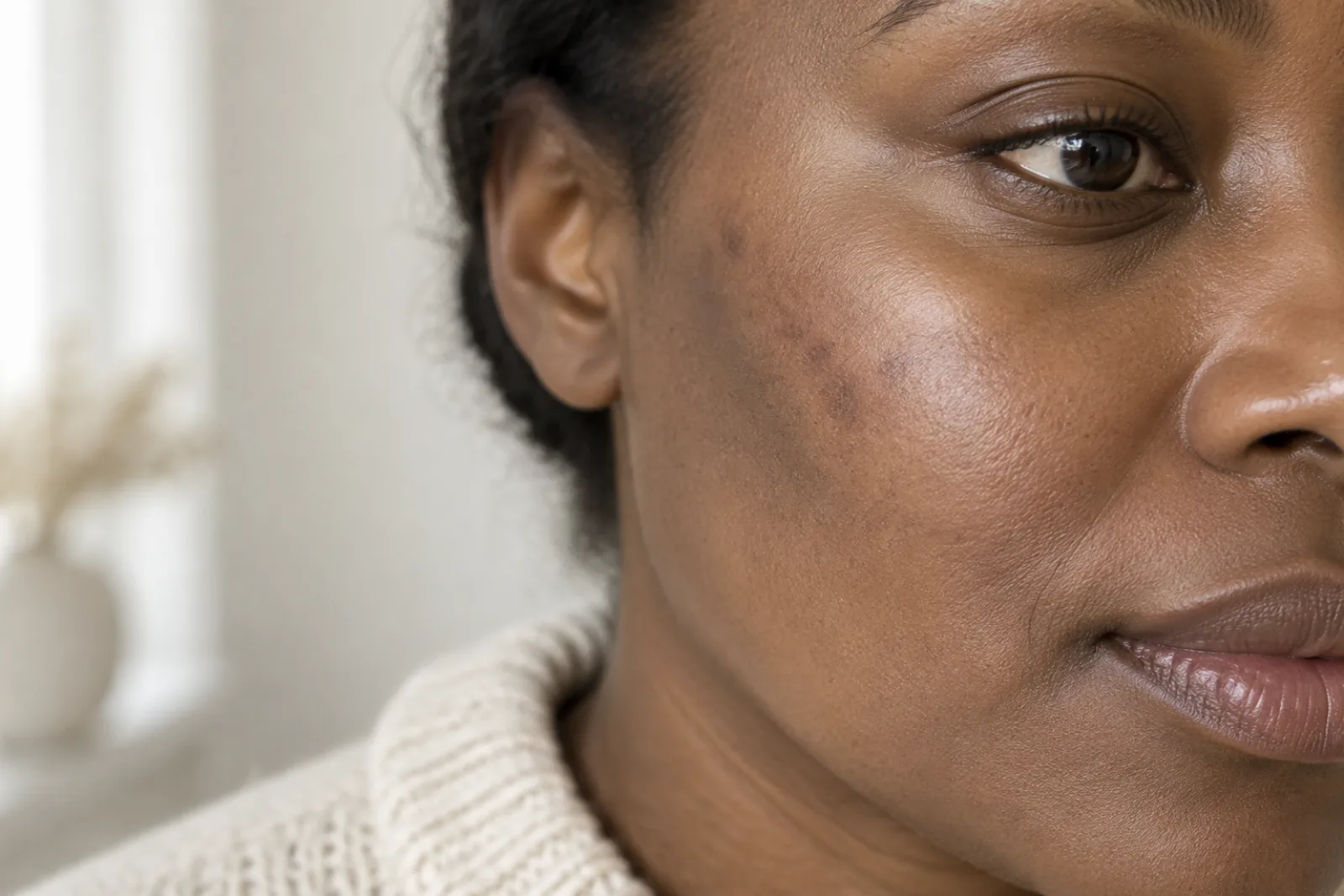
What is tranexamic acid and why does it come up for dark spots?
Tranexamic acid is an ingredient that slows bleeding. It blocks the breakdown of fibrin, the protein that makes blood clot. Doctors use it for heavy periods, for example. In skin medicine it is also used for melasma. Melasma means darker patches on the face, often on the forehead and cheeks. According to DermNet this happens outside the drug's licence, which is called off-label use.
How the ingredient acts on pigment is not fully understood, says DermNet. The idea is that it calms the tiny blood vessels in the skin and slows melanin production by changing how skin cells and pigment cells talk to each other. Melanin is the colour in your skin. A 2026 review adds that tranexamic acid may dampen tyrosinase, the enzyme pigment cells need to build melanin.
For you, with melanin-rich skin, that means: the ingredient is interesting, but it is not an everyday product like a vitamin C serum. It comes from medicine, and most of the data come from treating melasma.
[S2][S3]Does tranexamic acid help with hyperpigmentation?
For melasma, yes, several papers show it. A 2025 trial compared two routes in 50 women with melasma over twelve weeks: tablets with 250 milligrams twice a day and a 5% cream twice a day. The severity of the patches, measured with the MASI score, fell by 58.86% in the tablet group and 50.88% in the cream group. The difference between the groups was not significant. One woman in the cream group stopped because her skin was sensitive.
For the tablet in melasma, DermNet reports a success rate of up to 89%, with first results after eight weeks. It also points out that the patches can return after you stop. For the cream, DermNet wrote in its 2019 version that solid data from controlled trials were still missing.
The 2026 review collects studies on tablets, cream and injections into the skin. Its conclusion: every route reduced pigment, and cream and injections worked about as well as hydroquinone with less irritation. That is an overview of single studies, not proof. Also, for every figure here: the summary of the 2025 trial says nothing about the skin type of the participants. How strongly tranexamic acid works on very dark skin specifically, we can't read from these sources.
For the dark marks left after pimples or eczema, the picture is thinner. The review mentions them, but its focus is melasma. You'll find more on these marks in our article hyperpigmentation on dark skin.
[S2][S3][S4]Tranexamic acid as a tablet or as a cream: what's the difference?
The tablet is a prescription. According to DermNet the usual dose for melasma is 250 milligrams twice a day, and it is only an option if a dermatologist thinks it suits you. There are contraindications: a history of blood clots, heart disease, stroke, clotting problems, severe kidney failure, seizures and disturbances of colour vision. In a large case series of 561 people, 7% had complaints such as stomach pain, nausea, headache or ringing in the ears. One person developed a blood clot, but had an underlying clotting defect.
DermNet writes that a higher clot risk cannot be ruled out on current evidence. That's why a talk about your risk factors comes before taking it. So we say it plainly: never take tranexamic acid tablets on your own, not from the internet and not from a friend.
Cream and serum are something else. The cream in the 2025 trial contained 5% of the ingredient and was used under medical supervision. How much is in an over-the-counter serum and whether it works the same way, the studies can't tell you. We don't sell a product with tranexamic acid, so we can't recommend one.
[S2][S4]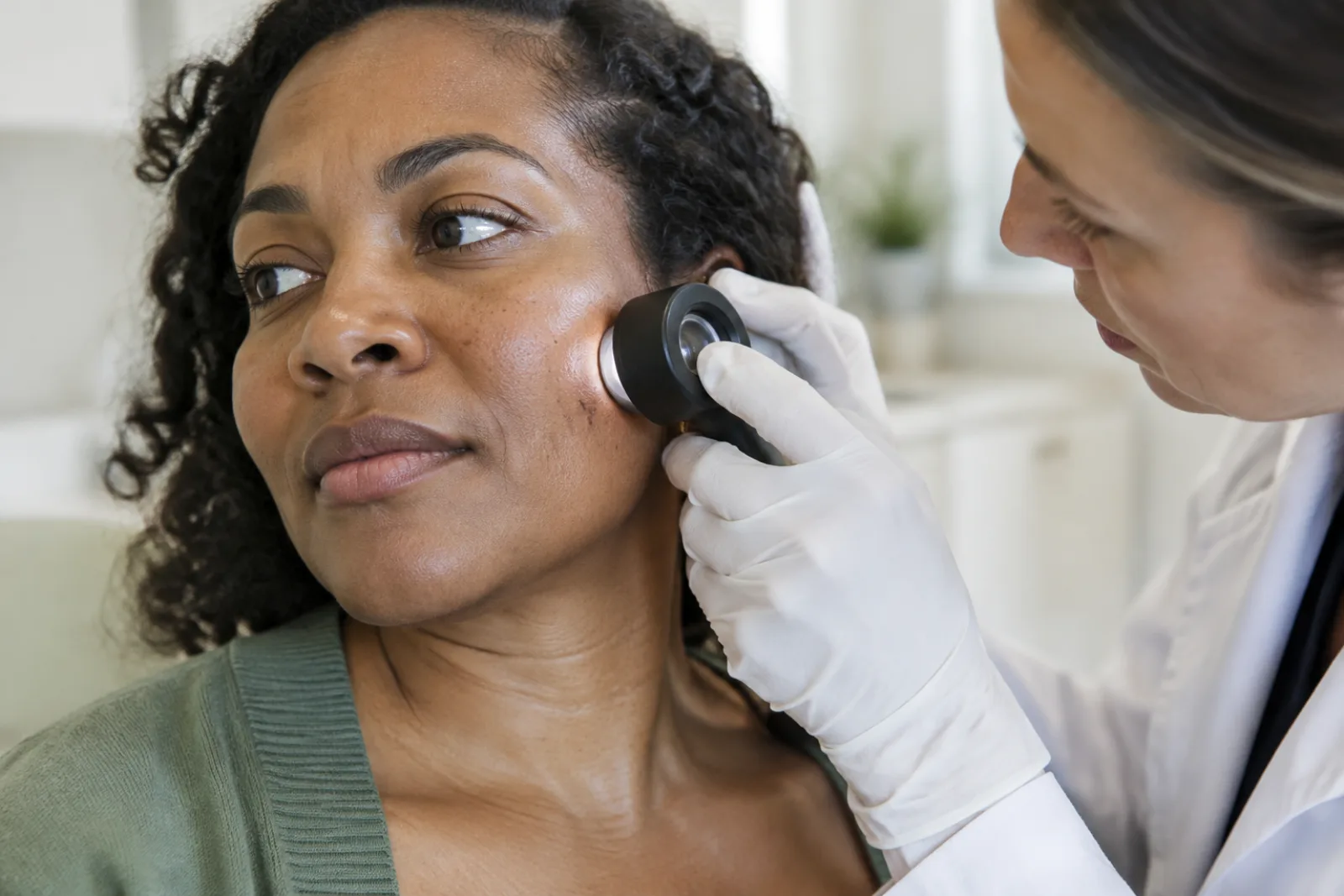
- 01The practice makes the diagnosis
Whether tranexamic acid is an option for you is for your dermatologist to decide.
Illustration
Is tranexamic acid safe in skincare?
On the skin the risk is smaller than with the tablet, because less of the ingredient reaches the blood. The 2026 review calls cream and injections better tolerated than hydroquinone. In the 2025 trial, one of 25 women using the cream stopped because of sensitivity. That is a single case, but it is a reminder that even well-tolerated ingredients can irritate.
That matters on dark skin. Inflammation prompts pigment cells to make more melanin. DermNet describes this for marks after pimples and eczema, and the AAD warns for melasma: if a product burns or stings, it is irritating your skin, and that can make dark spots darker. So test a new product on a small area first and introduce only one at a time.
No source gives you a guarantee. On top of that, DermNet says the safety profile for long-term use in melasma is not well studied. Get advice if you are pregnant, breastfeeding, take medication or have had a blood clot before.
[S2][S3][S4][S5][S7]What can you do about melasma without tranexamic acid?
Whether your patches are melasma can only be decided by a dermatologist. The AAD names sun, pregnancy and medicines such as the pill as triggers, among others. In some women melasma fades after birth, in others it stays for years. See the practice first. They will also work out whether tranexamic acid, another treatment or a combination suits you.
In care, sun protection matters even more with melasma. Visible light can make melasma worse, especially on darker skin tones. The AAD recommends tinted sunscreen with iron oxides and at least SPF 30, plus gentle, fragrance-free products. We are working on our own sunscreen. If you buy one now, choose a tinted one.
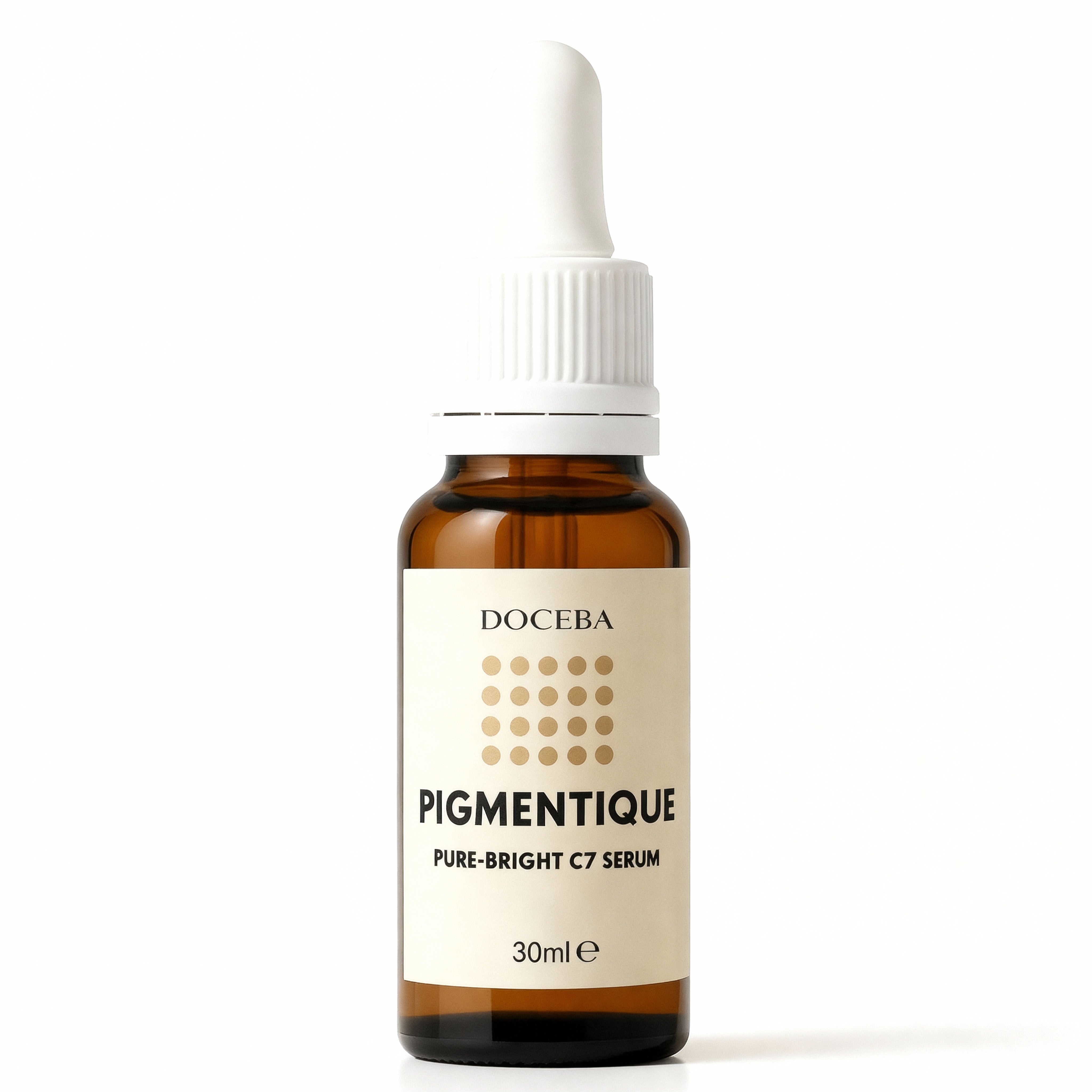
For care alongside that, you can use our Pure Bright C7 Serum. Our Mela Bright is still in development. If it is not linked here yet, it is not online yet.
[S1][S5][S6]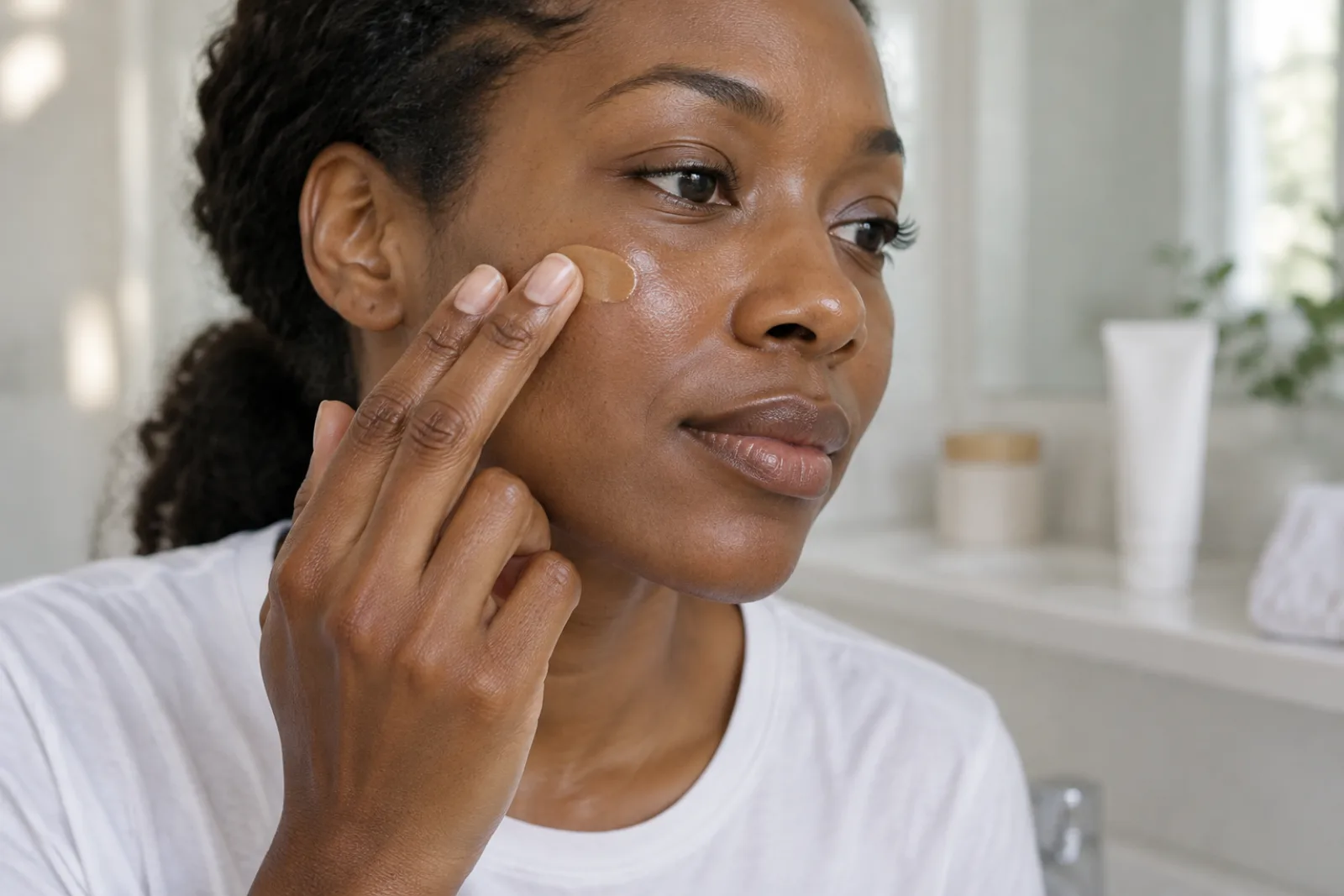
- 01Tinted with iron oxides, SPF 30 or more
For melasma, the AAD recommends tinted sunscreen with iron oxides.
Illustration
Tranexamic acid or vitamin C: what do you use for skincare?
The AAD names azelaic acid, glycolic acid, kojic acid, retinoids and vitamin C as ingredients that can fade existing spots. Tranexamic acid is not on that list. That doesn't mean it does nothing, the studies above say otherwise. It means that so far it is more a topic for the doctor's practice than a standard of over-the-counter care.
We don't have a product with azelaic acid, retinol or tranexamic acid, and none with hydroquinone either. Our serums rely on vitamin C. How vitamin C and niacinamide differ is in the article niacinamide vs. vitamin C. The full answer on vitamin C and dark spots is in vitamin C for dark spots. Another ingredient you can ask your practice about is compared in azelaic acid for hyperpigmentation.
Whether tranexamic acid and vitamin C work better together than alone, we can't show with our sources. A benefit is plausible, but not proven. Start with one product, give it time and take a photo at regular intervals in the same light.
[S1][S3]Your next step
Both paths are fine. Take the one that suits you today.
- Have dark patches on your face looked at once by a dermatologist, especially if you suspect melasma.
- Wear tinted sunscreen in the morning and patch test every new product on a small area for seven to ten days.
- Take a photo once a month in the same light. If you want tranexamic acid or another prescription treatment, talk to the practice about it.
Matching products from our lab:

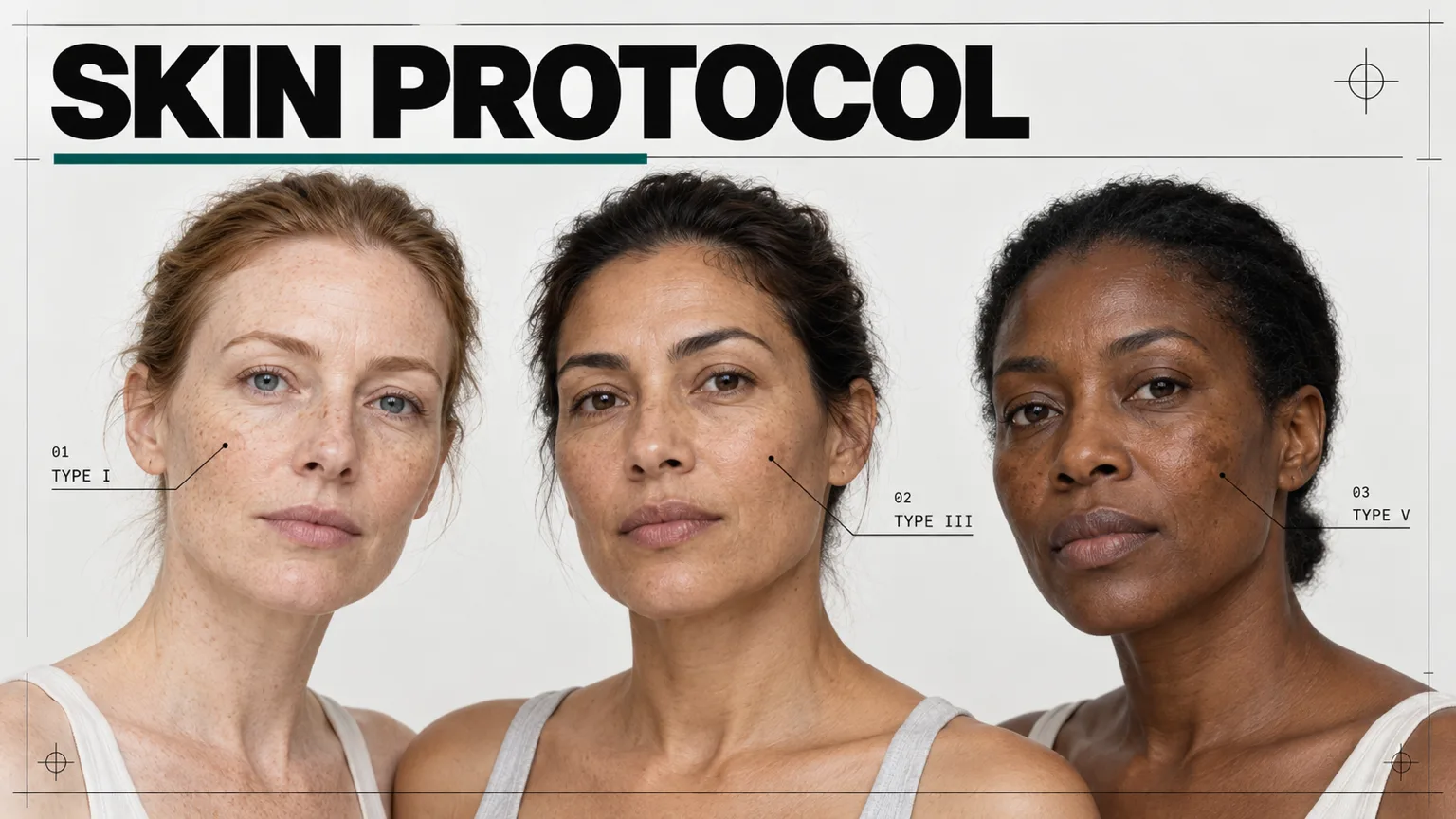
Skin Protocol: a plan for your skin and a team that adjusts it
You get a plan built around your skin and what you've already tried. We check in regularly and adjust products from Anita's lab when your skin needs something different. In English or German.
It starts with a free 20-minute call. We ring you and listen to your skin story, including tranexamic acid and dark spots.
Book your free skin callCosmetic advice, not a diagnosis. If you think you have a skin condition, see a doctor first.
Questions you might still have
Does tranexamic acid help with dark spots?
For melasma, studies show it can reduce pigment, as a tablet and as a 5% cream. For marks after pimples the data are thinner. We know of no separate analysis for very dark skin. Whether it suits you is for a dermatologist to decide. [S2][S3][S4]
Can I take tranexamic acid tablets on my own?
No. The tablet is a medicine with contraindications, such as blood clots, heart disease, stroke or kidney failure. For dark spots it is used off-label. Talk to a dermatology practice before you consider it. [S2]
Is a tranexamic acid serum safe?
On the skin the risk is smaller than with the tablet, but irritation is possible. In the 2025 trial one woman stopped the cream because of sensitivity. If a product burns or stings, stop using it, because irritation can darken spots. Patch test on a small area. [S4][S5][S7]
Sources
- [S1] AAD: How to fade dark spots in darker skin tones ↗
- [S2] DermNet: Tranexamic acid ↗
- [S3] AlJabr A, AlAnazi AMI, AlEtebi RAA: Tranexamic Acid for Hyperpigmentation Disorders: A Literature Review on Efficacy and Safety in Melasma and PIH. J Cosmet Dermatol 2026;25(2):e70692 ↗
- [S4] Heidary B et al.: Randomized Clinical Trial on the Efficacy of Oral Tranexamic Acid Versus Topical Tranexamic Acid in Treatment of Melasma. J Cosmet Dermatol 2025;24(9):e70428 ↗
- [S5] AAD: Melasma: Self-care ↗
- [S6] AAD: Melasma: Overview ↗
- [S7] DermNet: Postinflammatory hyperpigmentation ↗
- [P1] DOCEBA: Pigmentique Pure Bright C7 Serum ↗
- [P2] DOCEBA: Pure Brightening Set ↗
General skincare information, not a diagnosis or an individual treatment plan.
Your bag
Review your items before continuing.
Your bag is empty.