
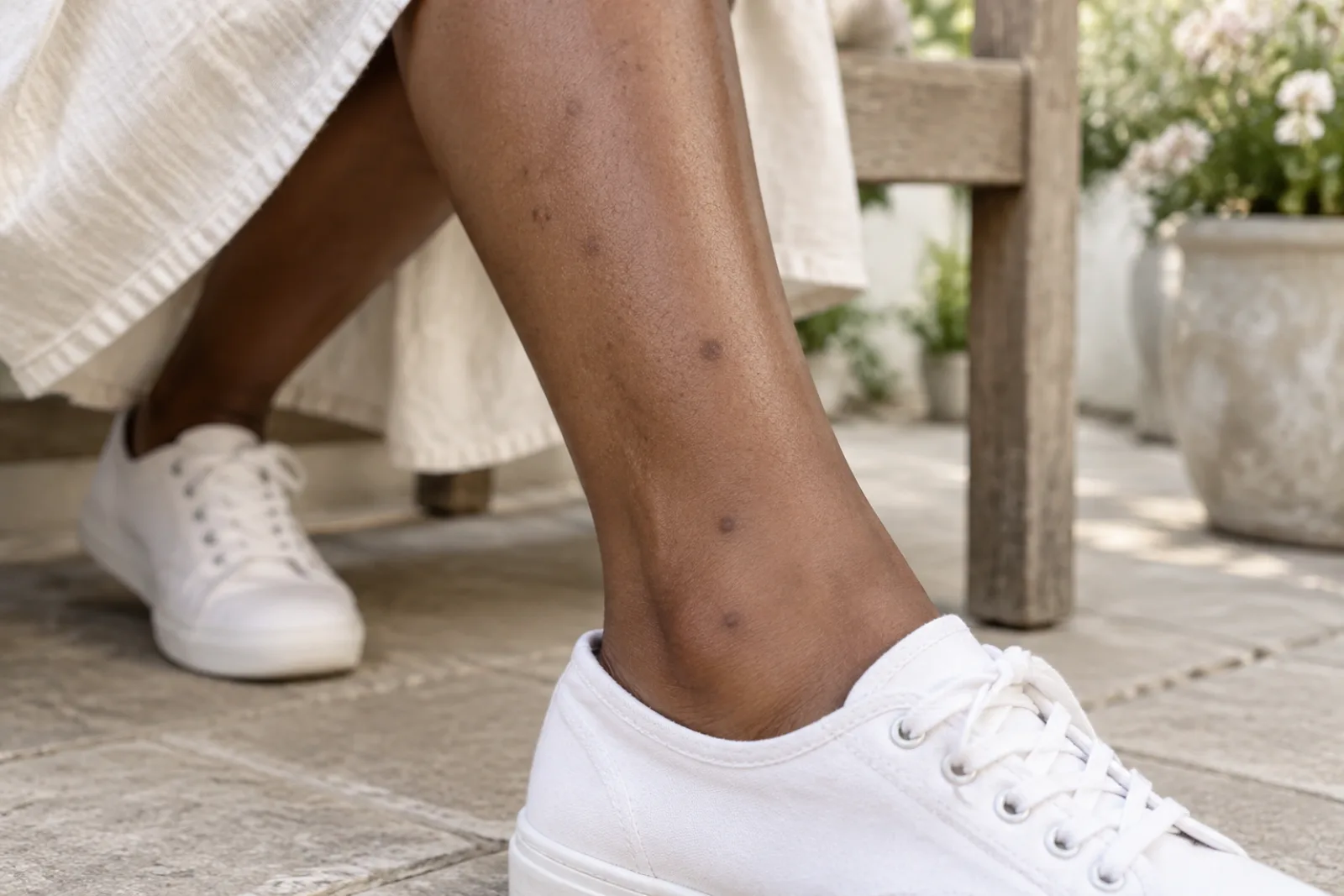
Why do mosquito bites leave dark spots?
The bite itself passes quickly. According to DermNet it causes a very itchy bump that usually settles within a few hours. Sometimes it lasts a few days with a small blister. What stays behind as a brown dot is something else: colour your skin laid down after inflammation.
Dermatologists call this post-inflammatory hyperpigmentation, or PIH. That means an inflammation prompts the pigment cells to make more melanin, the colour of your skin. DermNet says this affects darker skin types most often, with stronger colour that lasts longer. On skin rich in melanin, a single bite can leave a mark that lighter skin would not show at all.
This is how it usually goes:
- The bite: the spot itches and swells.
- The scratching: every scratch irritates it further. DermNet notes that scratching can leave an open sore.
- The inflammation: the more irritated the skin, the more reason the pigment cells have to make colour.
- The spot: once it heals, a flat, round brown dot stays behind.
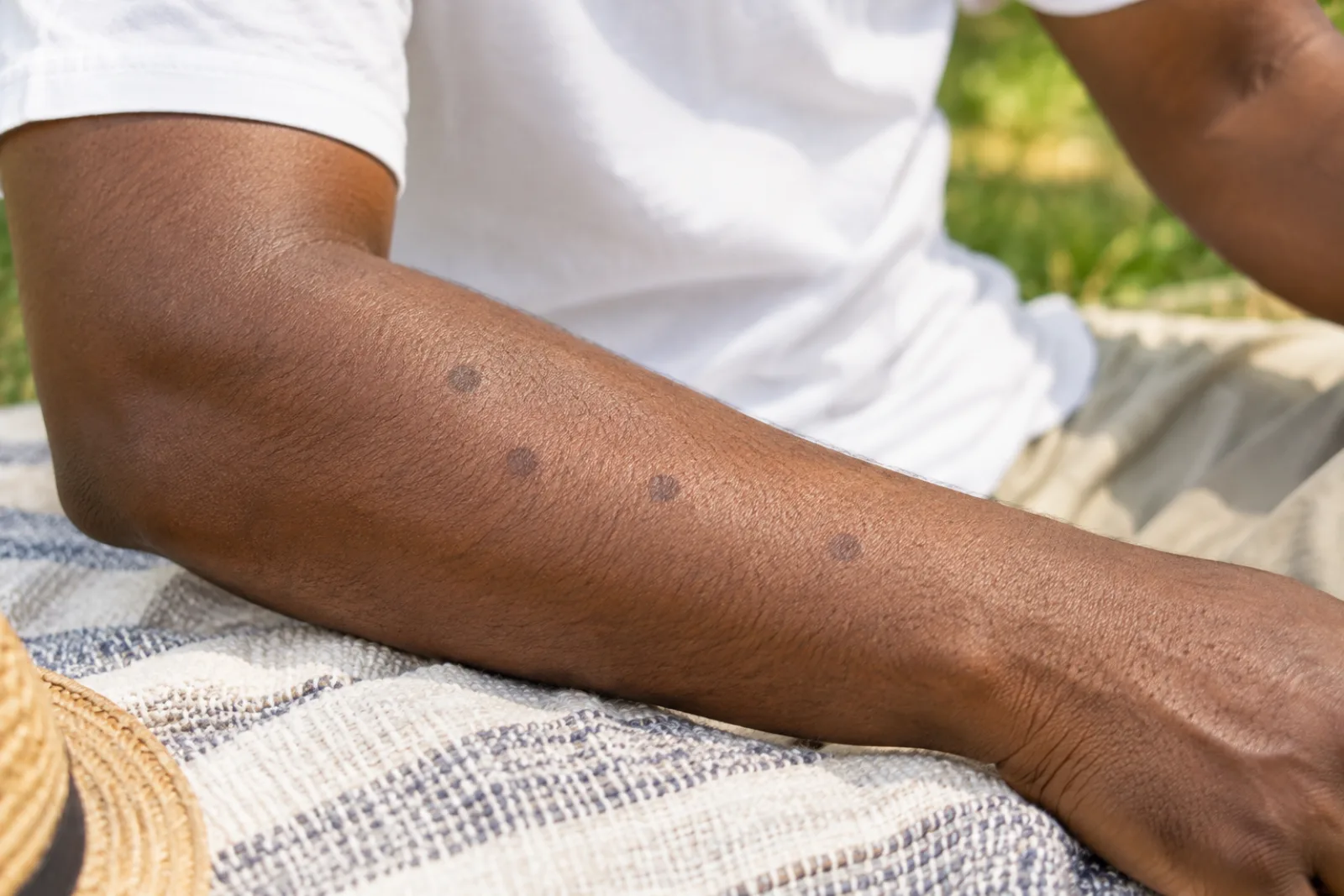
- 01Healed bite, only colour remains
- 02No redness, no swelling any more
Typical for summer: a few bites, and a few weeks later the marks.
Illustration
That is why it pays to keep the irritation small. You cannot change the bite, but you can change the scratching.
[S1][S4]What should you do right after a mosquito bite so no spot stays?
Nobody can promise that every spot is avoidable. You can limit the irritation, which is the trigger. The key rule is the same in every source: do not scratch. The NHS says scratching can lead to infection, and DermNet describes how scratching leaves an open sore.
Why so strict? For one, every scratched spot is one more irritation for the pigment cells. For another, DermNet names bacteria as a risk: staphylococci or streptococci can enter through an open sore and cause impetigo or cellulitis. An infection means even more inflammation, and the mark on your skin is more likely to get stronger.
This helps instead:
The order is simple: wash first, then cool, then something for the itch if you need it. If you scratch in your sleep, it helps to keep the area calm during the day and not keep touching it. The sooner the itch eases, the smaller the irritation stays.
- Wash the area with soap and water.
- Cool it: a cold pack wrapped in a cloth, or a cloth soaked in cold water, for up to 20 minutes according to the NHS.
- For strong itching, ask a pharmacist about an antihistamine or a hydrocortisone cream. The AAD and the NHS both mention these for bites.
- For children, or if you are unsure, get advice from a pharmacist.
How long do dark spots from mosquito bites last?
There are no exact figures for mosquito bites in particular. As a guide for dark spots in general, the AAD says a spot a few shades darker than your skin usually fades within 6 to 12 months once the cause is stopped. If the pigment sits deeper in the skin, it can take years.
The phrase “once the cause is stopped” matters. If the same spot keeps getting scratched or a new bite lands on it, the clock restarts. Summer spots on legs and arms are often an ongoing topic for that reason, because bites arrive in waves.
In children, papular urticaria sometimes occurs. According to DermNet, new bites join in and old spots flare up again. It then looks as if the spots never stop. The same rule applies here: leave the area alone, and if in doubt talk to your child's doctor.
You can tell bite marks by their shape: small and round rather than large patches. If yours are bigger, many, or appeared without a bite, read about dark spots on the legs for other causes. How the course of dark spots looks in general is in Does hyperpigmentation go away?.
[S5]Guide from the AAD for dark spots in general, not a promise. The time only runs while no new inflammation is added.
Do the spots get darker in summer?
They can. For dark spots the AAD recommends sunscreen with SPF 30 or higher and broad-spectrum protection, ideally tinted with iron oxides. Iron oxides block visible light, and that can darken spots too.
In summer the bite areas are exposed: legs, arms and ankles. If you cover or protect them, that is one problem less. We are working on our own sunscreen. If you buy one now, choose a tinted one.
Visible light is the point many people miss. A sunscreen without tint lets it through. A tinted one with iron oxides blocks it too. According to the AAD, that is why it recommends one for dark spots on darker skin.
[S5]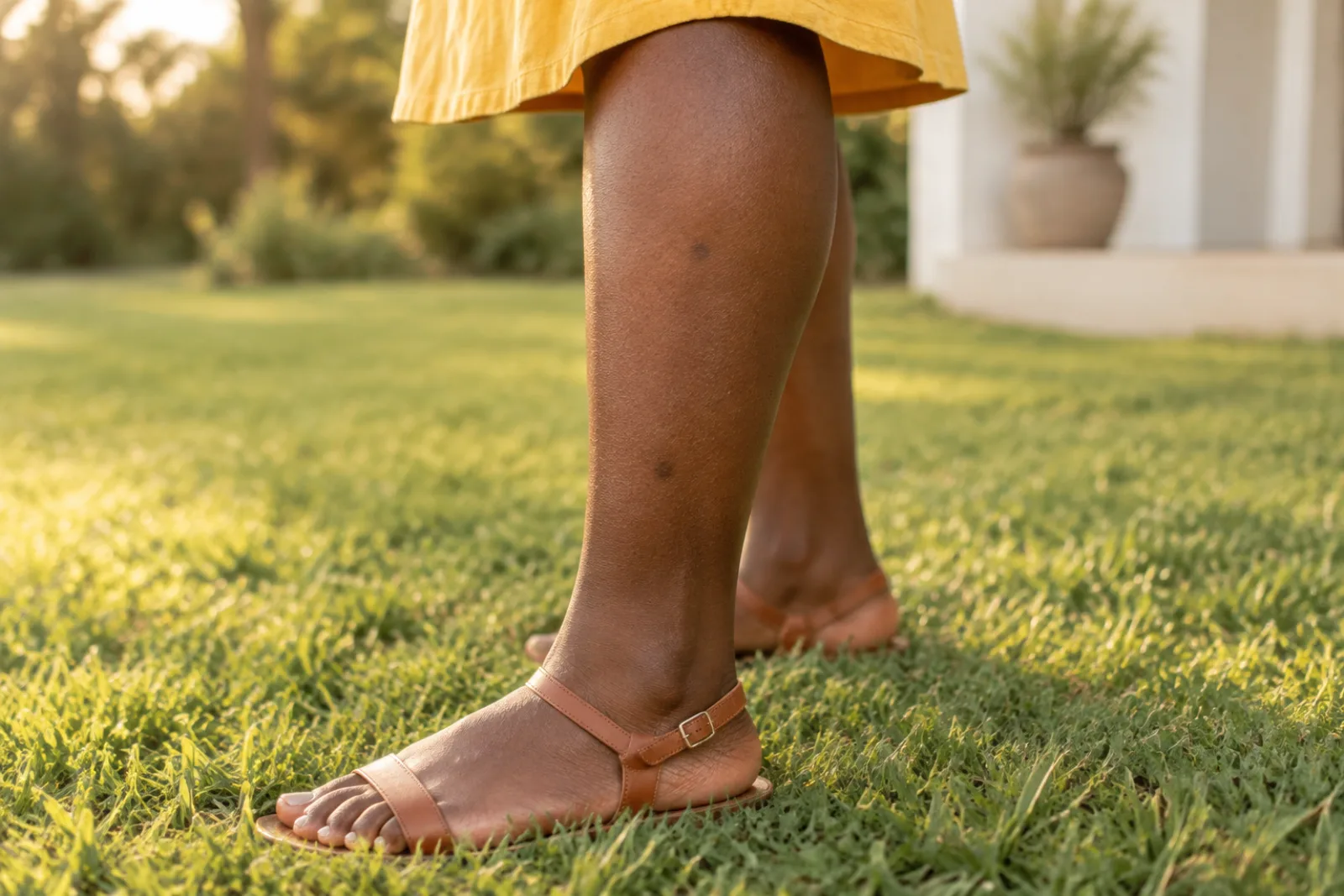
- 01Exposed in summer: sun protection
Legs and arms are bare in summer, and that is where the bites land.
Illustration
What helps when the dark spot is already there?
First: the spot keeps fading with time, even without a product. A product can speed up the fading, but it does not replace the basics: do not scratch, keep the sun off, leave the area alone.
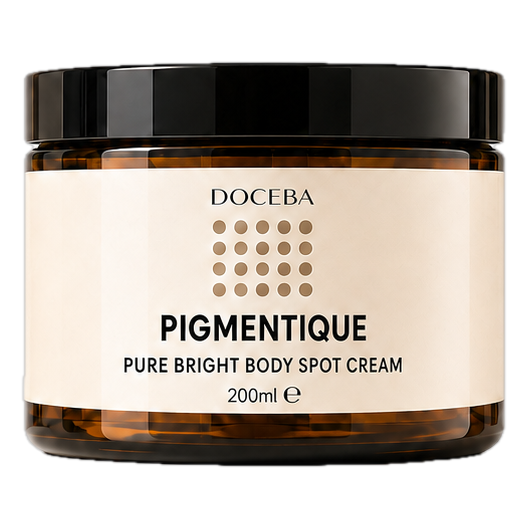
The AAD names azelaic acid, glycolic acid, kojic acid, retinoids and vitamin C as ingredients that can fade existing spots. We have no product with azelaic acid, retinol or tranexamic acid, and none with hydroquinone either. Our body products rely on vitamin C. They help dark spots fade visibly, which is a cosmetic effect and not a cure.
One thing matters: only use them once the area is calm again, meaning it does not itch, is not red and is not open. Test a new product on a small area first. The AAD says irritated skin can make spots darker, and DermNet says the same about inflammation in general. If a product burns or stings, stop using it.
Think in months, not days. A fixed routine makes it easier to stick with it that long: the same few steps morning and evening, each product introduced on its own. That way you notice what your skin tolerates. If something does not suit you, you know right away which product it was. For more on how dark spots develop over time, see Does hyperpigmentation go away?.
[S4][S5][P1][P2]When should you have a mosquito bite checked?
Most bites heal on their own. There are warning signs, though. The NHS advises seeing a pharmacist if skin feels hot or looks red, or if there is pain, swelling, pus or fluid. On brown and black skin, redness is harder to see, so watch for warmth and pain.
According to the NHS it is urgent if things get worse or do not improve, if you were bitten several times, or if you have had a serious allergic reaction before. Signs of a severe allergic reaction are sudden swelling of the lips, mouth, throat or tongue, fast breathing, difficulty breathing or trouble swallowing. Then call emergency services right away.
This belongs here too: a spot left after a bite is almost always a colour trace and not a danger. Still, only a dermatologist can say whether a spot really comes from a bite. If it changes, grows or bleeds, have it looked at.
If a spot lasts longer or gets bigger, or you are unsure about the cause, have it looked at in a dermatologist's office. We cannot give you a diagnosis.
[S1][S2]Your next step
Both ways are fine. Pick the one that suits you today.
- From today, cool a bite instead of scratching it.
- Cover exposed spots in summer with a tinted sunscreen.
- Once the skin is calm, test a vitamin C body product on a small area first.
- Take a photo every few weeks in the same light. If a spot grows or changes, have it checked by a doctor.
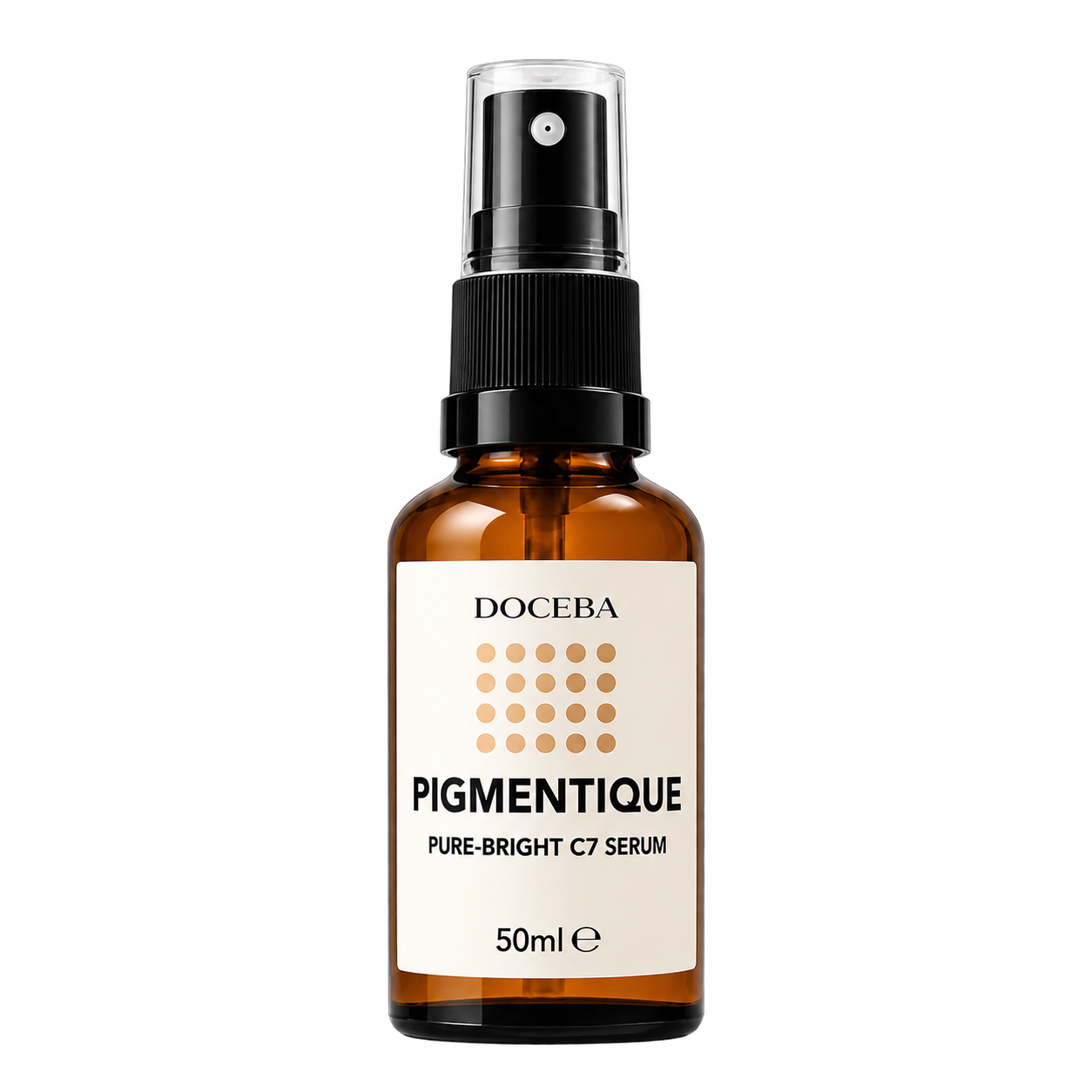
Matching products from our lab:
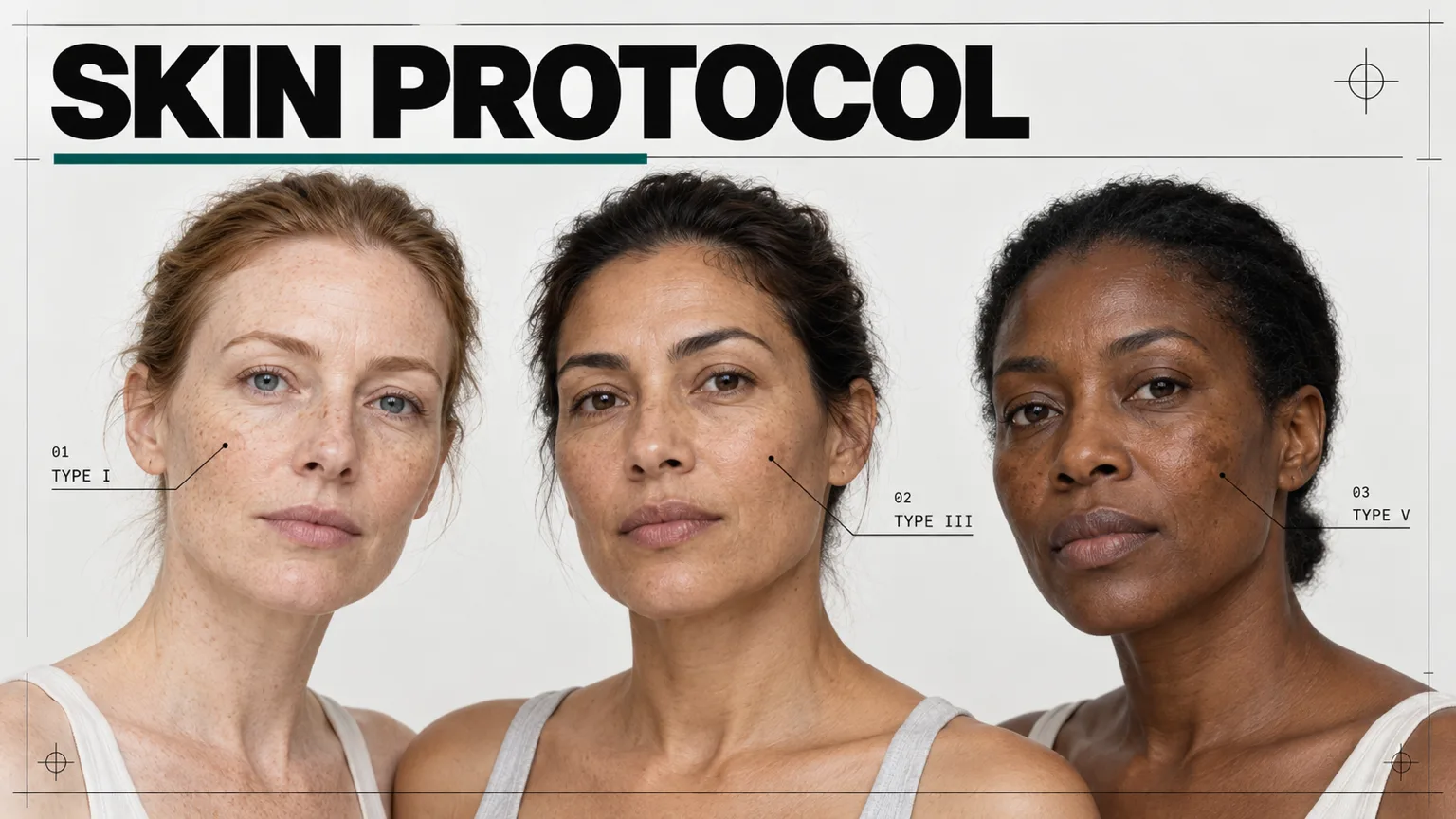
Skin Protocol: a plan for your skin and a team that adjusts it
You get a plan built around your skin and what you've already tried. We check in regularly and adjust products from Anita's lab when your skin needs something different. In English or German.
It starts with a free 20-minute call. We ring you and listen to your skin story, including your routine for dark spots.
Book your free skin callCosmetic advice, not a diagnosis. If you think you have a skin condition, see a doctor first.
Questions you might still have
Why does a mosquito bite leave a brown spot?
Because the inflammation prompts the pigment cells to make more melanin. Dermatologists call this PIH. According to DermNet it affects darker skin types most often, with stronger colour that lasts longer. [S4]
How long does it take for the spot from a mosquito bite to go away?
We have no exact figures for mosquito bites. As a guide, the AAD says spots a few shades darker than your skin usually fade within 6 to 12 months once the cause is stopped. If the colour sits deep, it can take years. [S5]
Does cooling really help with mosquito bites?
The NHS advises cooling the area for up to 20 minutes with a cold pack in a cloth or a cold wet cloth. DermNet lists cooling too. Cooling eases swelling and itching, and less itching means less scratching. [S1][S2]
Can I use my facial vitamin C serum on bite marks on my leg?
No. A face serum is made for the face. There are separate products for the body, such as our body cream and our body serum. Use them once the area is calm, and test on a small area first. [P1][P2]
When does a mosquito bite need a doctor?
With heat, pain, swelling, pus or if it gets worse, the NHS advises medical advice. Sudden swelling of the lips or tongue, difficulty breathing or trouble swallowing is an emergency, so call emergency services. [S2]
Sources
- [S1] DermNet: Arthropod bites and stings ↗
- [S2] NHS: Insect bites and stings ↗
- [S3] AAD: Tips to prevent and treat bug bites ↗
- [S4] DermNet: Postinflammatory hyperpigmentation ↗
- [S5] AAD: How to fade dark spots in darker skin tones ↗
- [P1] DOCEBA: Pure Bright C7 Body Serum ↗
- [P2] DOCEBA: Pure Bright Body Spot Cream ↗
General skincare information, not a diagnosis or an individual treatment plan.
Your bag
Review your items before continuing.
Your bag is empty.